30 October 2009

Resfrio and Final Countdown

Last week I once again had the pleasure of experiencing resfrío here in Guatemala - a head cold. A few weeks back I got my feet wet and I imagine that had something to do with me getting sick less than a month after my last flu. So much for the flu shot being effective. My head cold was made more unpleasant by the surprisingly strong winds that suddenly came up after I returned from site visit. In late October the winds start to blow and the rain stops (though that is not totally accurate, we did get some rainfall this week) and it got perceptibly colder (though any East Coast person would tell me to suck it up, we are talking probably mid-50s). It was not ideal timing to get sick and cold at the same time since I left everything in my new site, including my medical kit and all but one long sleeved shirt, but hindsight is 20-20, so from now on I know to always keep Sudafed close at hand and to bring at least one change of clothes since you get funny looks when you layer short-sleeved t-shirts to maintain body heat.

Besides feeling cold and congested, this week consisted of tying up a lot of loose ends at Peace Corps. We went to the Peace Corps office every day from Tuesday through Friday last week and once again on Monday and Tuesday of this week to finish up trainings and share our experiences from site visits.

Last Tuesday we all met up in a group and discussed our experiences on site visits and I was once again reminded how lucky I am to be going to my site. Some other folks had housing issues (the two guys gave us updates about their latrines), traveling to and from site was an involved process (the guy going to one site near the Mexcian border left at 2am to get back to Antigua around 3pm), and others have more severe weather conditions (extreme heat in the East and extreme cold in the West). On Tuesday night all of us San Antonio kids were invited to Felicia’s host mother’s house for a despedida – goodbye- dinner of tamales. We had our two weeks of Spanish class in the beginning of training at her house, so her mother wanted to say goodbye to all of us officially. It was a wonderful meal; the tamales here in Guatemala are significantly larger than Mexican tamales and along with having a filling in the corn masa, they also mix in tomato sauce throughout the whole tamale, so it is really really tasty.


Last Wednesday we went back to Peace Corps for more technical training and to start our two days of indigenous language training. Some people are obligated to learn an indigenous language because of their sites, and Peace Corps will pay for them to take 80-hours of language training in their sites. In order to get them started on the process and to also expose those of us who do not need to take a language to the culture, we were given two days of Mayan language. I went to the K’iche’ class (there were also Kachiquel, Mam, and K’ekchi’ classes offered) along with three other agriculture volunteers who will all actually have to learn K’iche’ in order to do their jobs. The class was really interesting, for example, we learned that one reason that people in Guatemala often say things like ‘I want to buy one my tortilla’ is because in K’iche’ the word tortilla gets a personal possessive in the sentence, so instead of saying ‘I want one tortilla’ it literally translates to ‘one my tortilla.’ We learned the basic words for greeting people and introducing ourselves, and it was really neat, but I am so thankful that I will not need to learn K’iche’ for my site because I essentially forgot everything the minute I learned it. Here is my best recollection after four hours of class:

Xsaquarik, nub’i’ Athalia.Utzwachlaa? (Good morning, my name is Athalia. How are you (formal)?

Utz, matiosh.Utzaawach? (Good, thanks. How are you (informal)?

Utz, tiosh. (Good, thanks)

We learned more, or maybe it is better to say we were shown more, but I was not too quick on catching on. The verbs, for example, rather than conjugating like Spanish words (most time the root stays the same and only the last part of the word changes depending on who is being spoken to) have changes both at the beginning, the middle, and the end. The verbs we learned all had four letters, but then in the conjugation process for eight different tenses, the first letter changed according to the tense (a present-tense verb starts with k- and past tense begins with x-), then the last two letters of the verb are dropped and letters are either added before or after the stem depending on the tense. It is not at all intuitive, and the multiple “ ’ ” indicate a glottal stop (I think that is the term) so there is a lot of throat action.

On Friday multiple volunteers from the Municipal Development program who are one year into service or finishing up right now visited us to discuss their experiences. There were seven panels about various topics related to being a volunteer (how to deal with machismo, secondary projects, living arrangements, etc). The panel was kind of a last chance clear up doubts or questions that we had before going to site and at the end of the talks we held a vote for the Municipal Development council. Our program has a council with two reps from each year that give feedback to our APCD (Associate Peace Corps Director) about how to improve the program/training/etc and plans out follow-up trainings throughout service. In a field of three candidates I won one of two spots on the board for my group, and I am really excited that I will get to help mold the program for future improvements and that every three months or so I will meet up with the other three council members (who all enjoy baking!) to plan for muni-specific events.

Last Saturday I got fed some more tamales as part of the weeklong despedida. This time, my host mom’s daughter-in-law, her nuera, made them for me, and I got to participate in the process. My first weekend in town my host mom’s nuera made tamales and I had mentioned that to close the cycle of my time here that we should eat them again. She took my suggestion to heart and spent Friday night through Saturday night working on tamales. I helped out by stirring the masa as it was cooking (the corn to make masa is cooked three times: first as corn before it is taken to the molino to make it into powder, then again with water and oil added to get the right texture, and finally as part of the tamale) and by tying every single tamale shut.

On Sunday in order to reward me for being a good host daughter, my host mom invited me to go with her to Antigua to visit some ruins. Despite being near Antigua for almost three months now, I had yet to enter any ruins since I saw that non-national visitors had to pay Q30 and I figured that when visitors came to see me they would help defray those costs. The opportunity to go with my host mom seemed like too good an opportunity to miss out on, so together with her nuera and granddaughter I went with my host mom to visit Los Cachupines. Los Cachupines is the ruin of a convent where nuns who got pregnant by priests were sent to live in cells. The museum was closed since it was a Sunday, so all that I learned about the place came from my host mom, but even without too much explanation, the ruins were amazing.

Courtyard in Los Cachupines

Under the cells
My host family in front of some of the nuns cells

After spending the morning exploring Los Cachupines, we headed over to the church San Francisco El Grande, where there are more ruins and the tomb of Santo Hermano Pedro. Santo Hermano Pedro was a Franciscan priest who came to Guatemala in the 1600s and was known for his work with the poor and sick. Apparently he used to go around at night wearing a cloak and carrying a lamp calling out to people something about saving souls. He died young (only 60 years old or so), but soon after his death the process began to have him canonized as a Saint. People claim to seem him sometimes at night (on more than one occasion I have been told about people who were homeless or on hard times being approached by a cloaked man at night who gave them lots of money and then disappeared). The church holds Hermano Pedro’s remains, though they have been exhumed five times they have stayed in the church for 300+ years, and in 2002 Hermano Pedro was finally made a saint. At San Francisco, we sat next to the ruins of the convent that used to be there and ate lunch, avocado and tortillas, and then entered the church to see the tomb where Santo Hermano Pedro’s remains reside. My host mom used to sell artesanía outside the church for thirty-some years, as do many women from my town, so she was really knowledgeable about the church and Hermano Pedro. Along a wall next to the third tomb where Santo Hermano Pedro was buried there were tons of placards giving thanks for miracles.

It was a really awesome day and I cannot wait for some visitors to come at some point so I can have more excuses to visit other ruins since they are literally all over the city of Antigua.

Monday and Tuesday were spent at Peace Corps going over training (both taking tests to ensure that we have learned what they wanted us to learn and also giving feedback on the training process). Wednesday was our last day in site and Felipe and I went to the municipality’s OMP (Oficina Municipal de Planificación) to give our formal presentation of the SWOT analysis we did of the office. It was really nice to hang out in the office one last time, and the feedback we gave to the personnel was really well received. After lunch, I went by my local tortilla shop to say goodbye to the lovely ladies who helped teach me how to make tortillas. They let me take some photos of them working and told me that any time I want to come back that they’ll be waiting for me, so when we have to return for training in Peace Corps I will also be able to brush up on my tortilla-making skills.

In the afternoon I went with Felipe’s host mom and brothers to Antigua to visit the ruins of San Francisco (when I went on Sunday I did not enter the museum and ruins). On the way there I saw a beautiful street:


Next to the church of San Francisco where Santo Hermano Pedro’s remains are interred are the ruins of the old Franciscan convent that used to be there and a museum dedicated to Santo Hermano Pedro. The ruins are pretty extensive, covering a city block essentially, and they were surprisingly well preserved in some areas, with painted murals still intact.

Ruins of San Francisco
Paintings from the 1700s or earlier still on the wall
Doña Estela in San Francisco ruins

It was really neat to see more ruins and share the experience for the first time with Felipe’s host family, who despite being so close had never come to the ruins before.

18 October 2009

Site Visit

This week was the much anticipated counterpart day and site visit. As usually occurs whenever I am excited about anything, I was unable to sleep most of the week because I was so thrilled to be going to and then in Pachalúm. On Monday I woke up at 5:15 am to get myself to Peace Corps on the early bus that goes directly to Guatemala (saving me time traveling and money since I do not have to transfer in Antigua). I waited around for half an hour and the bus did not show up, so I had to take another bus that only went to Antigua and then transfer to get on to Santa Lucía. When we got to Santa Lucía we found out the reason that our bus did not come: road blockades across the city. Apparently in honor of Columbus Day (or as it is known here, Día de Hispanidad) some campesinos decided to blockade all the roads into Guatemala City and also some other towns across the country. Slowly counterparts started coming in from all over the country, but mine was nowhere to be found. After waiting around for two hours, Peace Corps decided to start programming at 10am despite some missing counterparts. I felt like one of the kids who is left at school waiting for his/her parents after all the other children have been picked up, but luckily the morning activities were pretty basic. Counterpart day is more for the Host Country nationals to familiarize them with what Peace Corps is and to make clear what they can and cannot expect from volunteers (we are not a religious organization, we are not secretaries, we are not being paid big salaries, we are not part of the CIA, etc). At lunch I sat with Laurie and her two counterparts, two ladies from a women’s group in Chimaltenango, until finally around 1pm Luz María and Ada showed up for me.

I met Luz María when I visited Pachalúm on August 29th, she is the coordinator of the OMM and my official counterpart. Ada is the girl in charge of the agriculture office, who along with working for the muni goes to school on Fridays and Saturdays to study agronomy (which is why I had not met her before). The rest of counterpart day continued to be pretty basic, but I was very excited to have my counterparts with me. Luz María has been working in the OMM for about 6 years and has had two volunteers before me, so she is well aware of what Peace Corps does and does not do, and she came prepared with a three month plan to start out.
On Tuesday I once again woke up super early ready to go to Pachalúm. The municipality was picking us up with a car, so I packed my two big pieces of luggage and left just a little clothing for the rest of my time in San Antonio. At Peace Corps we went over cultural differences and expectations a bit, and then at 1030am we got our bags and everyone headed out with their counterparts to get to site. María Alejandra, the volunteer I am replacing, and Don Miguel, the municipality driver, met Ada, Luz María and me and we all headed to Antigua to drop off some of María Alejandra’s luggage and to buy supplies for the municipality’s feria on October 24th. Before leaving for Pachalúm we went up to the top of the Cerro de la Cruz, a hill that overlooks Antigua, to take some photos and enjoy the view.

Vista from Cerro de la Cruz


With Luz María, Ada, and the cross


Around midday we finally headed out to Pachalúm, leaving Luz María on the way since she had a previously scheduled event to attend in Retalheu (another department) for Wednesday and Thursday. We drove the route that I will have to take from Antigua: Antigua to San Lucas, San Lucas to San Pedro, and then San Pedro to Pachalúm via San Juan Sacatepéquez (a large municipality and only one of 7 in the country with a female mayor). To get to Pachalúm we drove through four departments (Sacatepéquez, Guatemala, Chimaltenango, and finally El Quiché) and the ride took about 2.5 windy-road filled hours. When we finally arrived in Pachalúm it was about 4pm it was pouring rain. I spent the week in María Alejandra’s place, a house that she is living in for free since she is a friend of the owners. The family that owns the house comes to stay every weekend in order to make Arroz con Leche to sell on market day (Saturday), but otherwise the house is all hers, and it is really nice and large. María Alejandra is going to be leaving Pachalúm next week to head back home and will give me her bed, TV, and other sundry items that she is not taking with her (a toaster oven, garbage cans, mirror, stools, some shelves), which is going to help me save up money for my big investments: a refrigerator and stove top. Ale was the hostess with the mostest, taking me all over town to meet people, cooking amazing meals, and telling me about all her work and experiences in town. On Tuesday night I also met my site mate for the next two years: Tiara, the first Youth Development volunteer in the municipality. She has been in site since mid-July, is from San Bernardino, has a master’s in Social Work, and will be my company for the next 21 months once I get to site.

On Wednesday Alejandra took me around to meet people in the municipality, including a meeting with the mayor. My office is on the third floor of the municipal palace (that is what the building is called) and it is a shared office with Ada from Agriculture, and Hilario, from the Office of Forestry. Hilario is familiar with the program ArcGIS and I am really hoping that we can work together to do a census with basic socio-economic data. This will require some quick learning on my part since I have absolutely no idea how to use the program, but from what I have seen it looks really neat since you can use graphics to illustrate information (for example, I imagine doing a map with pie charts for illiteracy levels in all the outlying communities). Alejandra also took me to visit Doña Antonia, the woman whose house I will live in for the next three months. Doña Antonia lives near the muni building along with her two daughters, a son in law, and from my count three grandchildren. Above her garage is an apartment complete with a bathroom, a living room, and a bedroom, which will be mine all mine. As I acquire cooking supplies I will set up my kitchen in the living room area, and I also intend to take full advantage of having couches to recline on since in my current house we only have beds to lie on, and that is kind of gross when one is in street clothes.

Alejandra also took me to see the year-old school for children with special needs, which was established with the help of the OMM. Ale and Luz did a survey last year and found that there were at least fifty children who would benefit from such a school, though only ten or so actually attend now that it has been established. The school has two teachers and a physical therapist, and it is downstairs from the library. Since I am arriving to site as soon as summer vacation begins, it looks like I will be spending a good amount of time at the school with Luz for the first month to continue classes with the children while their teachers are on break. I really want to try and do tire gardens and world map murals around the school area and hope that some of the children could help with that process.

On Wednesday afternoon, Tiara took me to see her apartment and the empty apartment next to it where I might move after three months. The apartment is super nice, upstairs from a store with a private entrance; two bedrooms, a bathroom, and a nice kitchen sink area. Ale lived there before her friends offered her use of their house and I am thinking that it will be my future abode so that I can host guests (hint hint readers). Tiara also took me to see the post office, greet the national police, and by the school where she has been working. At the post office I found out my new mailing address for anyone who wants to send any letters or packages (and I recommend sending items there since there has been a lot of theft from mail going to the Antigua address). The mailing label should read:

Athalia Markowitz
Voluntaria de Cuerpo de Paz
Municipalidad de Pachalúm
Pachalúm, El Quiché, GUATEMALA
CENTROAMÉRICA

On Wednesday evening Ale and I headed over to 107.9, Pachalúm radio, to do a broadcast of La Voz de las Mujeres, the weekly half-hour broadcast of the OMM. The broadcast can be found streaming live on pachalum.net.gt, and the show currently airs on Wednesdays from 5-5:30pm, though we are going to change it to the morning since a lot of the times if one is going out to the communities it is hard to get back in time. I was really excited and nervous to do the radio show, but I think it went pretty well despite not really practicing at all (not that I got any feedback from the guestimated 200 listeners or so, but I’d like to think of myself as a natural). Ale and I discussed Breast Cancer and how to do self-exams and it was really fun. When I get to Pachalúm I plan to taking some basic radio classes that the muni will be offering to youth to figure out how to operate the equipment, which Ale says is pretty easy to handle.


Before the radio show


On Thursday morning Ale and I headed out to visit one of the communities where she has been working with a women’s group called Cipres del Campo. Pachalúm has about thirty communities outside of the municipal center, or cabecera, and they are somewhat difficult to access without a car. Around fifty families live in Cipres del Campo and maybe 13 women showed up with their children to meet me on Thursday morning. Ale helped create a pila project for these women, a proposal that needs to be approved in the budget to get these women pilas for their houses. If the project is approved I will be the one continuing it with the women in this community and another one.

On Thursday afternoon Ale and I went to the Parque del Paisano Ausente (the Park for the Missing Countrymen – in reference to all the people in the USA) for a big celebration. Over fifty women and men were graduating from CONALFA, a government run program to eradicate adult illiteracy. Along with CONALFA, there is a Cuban teacher working in Pachalúm with the Cuban program ‘Yo Sí Puedo,’ to help eradicate illiteracy in the municipality. There were officials from all over to help officiate the ceremony, and the mayor took the opportunity to introduce me to the assembled masses.


Being introduced at the CONALFA Clausura

The ceremony was lovely, and at the end all the graduates were given viaticos, bags filled with basic food items, as an extra incentive for having participated in the program.


Most of the graduates with their certificates


On Friday Luz finally came back and we discussed some of the work that we would undertake my first few months in site. We are probably going to start with two women’s groups, work with the special education school for the whole month of November, do some summer camp activities with all the children of the municipality (I volunteered to give swim lessons – I am secretly hoping to teach all the kids to swim and then start a water polo league!! This will require me to brush up on the rules of the game since all I really remember is how much fun it is to foul), and start doing a census of the population. Friday was Ale’s birthday, so we set up a surprise birthday for her, complete with gifts and cake to celebrate both her birthday and her impending departure.

At the birthday party I got to know one of the muni workers’ baby, Emilio, who might very well be the baby to help me get over leaving Kenny in San Antonio.

Emilio and Rosy


Friday afternoon the mayor gave Ale and I a ride all the way to San Lucas, which was very nice of him and will make my return trip to Pachalúm exciting since I have still never gotten there by bus. Two more weeks of training to go, but my heart is already in Pachalúm!

10 October 2009

Mi Sitio y Traje Típico

This week was the huge lead-up to finding out my site on Thursday morning. The lead-up was extremely tense, everyone has only been talking about site placements since Field Based Training and curiosity was killing this cat. All week I was having dreams about my site placement, and on Thursday morning I woke up before 6am nervous to find out where I would go. At 10am I was in the plaza of San Antonio anxiously waiting for Roberto to come and tell me my destiny for the next two years…and I waited and waited. Roberto rolled in half an hour late and after he finally found parking, we listened to a short discourse about how he looked for volunteers to fill positions in municipalities that requested volunteers, not municipalities to meet our requests. Finally, he took out four colored folders with our site assignments. Devon is going to be replacing a volunteer who has been working in the OMM in El Chol, Baja Verapáz; Felipe is going to be going to a new site called Escuipulas Palo Gordo, San Marcos; Felicia is going to a new site in San Jacinto, Chiquimula and I am going to….PACHALÚM, EL QUICHÉ!

This is the site that we visited early in training to see the volunteer María Alejandra who is finishing up her service in the OMM. I am thrilled to be going to my site, which I daresay is the most developed of all the municipalities (wireless internet in the municipality, park, and library and a radio program which is broadcast online). In my folder I learned that my municipality is 100 square kilometers, has 8,000 residents, of whom 2,000 live in the municipal cabecera (the main town), the rest living in aldeas or caserios (smaller towns). Pachalúm was never affected by the civil war (unlike the rest of El Quiché), and it is the youngest of all the municipalities in the department (it was formed in 1986). The municipality is 95% ladino and the closest large city to me is Guatemala City around 70 km. away.

The reason that Pachalúm is so developed is because of its large ex-pat population, which lives mostly in Nueva Jersey and sends money back. This has resulted in the town having lots of visible wealth (houses have multiple stories, the municipality is highly technologically advanced), but the local economy is not necessarily very strong since none of the money is being made in the community. A weird aspect of having such a large ex-pat community is that there are not that many young people in town, especially men. I did not really observe this on my visit earlier, but I am interested to learn more about it when I go back. The municipality has had two previous municipal development volunteers, so I am the last in the line, which is a little sad (since whatever work I do will be it, I cannot leave projects for someone else to continue). I am going to be living for my first three months in an upstairs apartment in what Roberto told me was one of the nicest set-ups (though after talking to others I am no longer sure since he has told everyone that their living situation is enviable).

I have one site-mate in town working in the Youth Development program, and there are plenty of volunteers nearby (including Devon, who is only an hour away). The rest of the training class got their assignments yesterday as well and a ton of them are heading up to San Marcos and Huehuetenango. It was all very exciting to find out where we were going, and I could not even sleep well the following night since I was thinking about finally going to my site next week and what I would be doing. I am excited to continue working on the radio broadcasts that María Alejandra has been doing (I will keep you all updated so you can listen in when it streams online) and also on updating the OMM blog. I am not sure what other projects are currently being done that need to be continued and what new projects I will get to start.

On Friday morning, I did not really have anything to do, so Mamatina decided that it would be as good of a time as any to take some photos in traje típico. Following are the photos from our modeling shoot on Friday morning. I hope you all enjoy the weekend and I look forward to updating you on how my site visit goes next week!
With Mamatina in outfit #1With Mamatina, Betsy, and ElsaWith Betsy
Outfit #2 and we busted out the catI liked the braids with pompoms so much I wore them all day

06 October 2009

PACAYA

On Sunday I went to one of the three active volcanoes here in Guatemala. Pacaya is located in the department of Escuintla, and ever since 1995 it has been spewing lava, which added to its close proximity to Antigua, make it a hot tourist destination. Almost everyone from the group (25 out of 32) went to Pacaya in order to see the lava up close and personal, and we got a great deal since the Ecotourism PCV on site went up with us. The group pre-hike

Jesse is the seventh volunteer at Pacaya and he described to us how it is a really challenging site to work in since it has been so successful and people have gotten so flush with money that it is hard to convince them to change anything (for example, money is not invested in improving the park so when one day the lava stops flowing there will be no draw for tourists anymore and the local economy will be in trouble).
View of the mountain in the distance

We started climbing up Pacaya around 11am and arrived at the lookout point around 1pm. View of Pacaya from grassy knoll
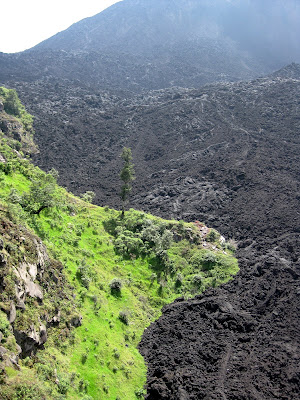
The view was really magnificent, and as we ate lunch on the grassy knoll looking at the volcano and its lava flows, we could see people climbing up at the crater, which we thankfully did not attempt to do (we did not have any time…and it also seems unnecessarily dangerous). Lava flow
While we were eating lunch, tons of fog blew in, which made us feel like we were in a cloud. In the clouds with Cara, Shani and Devon

After we ate, we headed down to the lava flows, some of which are cold, and some of which are still flowing. To get to the lava flows, we had to go down a mountain of volcanic ash, which had the consistency of freshly fallen snow.
Running down the lava flow
At the bottom of the mountain we got to some of the older lava flow and walked through it to get to the newer flows. The fog was intense and some people were commenting that it looked like Armageddon.


In the lava flows
When we got to the new lava flows, we literally were only a few feet away from hot flowing lava. The sun broke out at this point as the fog dissipated and it was REALLY hot every time the heat waves from the lava blew our way (I can now appreciate how a roasted chicken feels in the oven). Along with getting to see the lava up-close, the coolest thing about being near the flow is listening to the sound of the lava as it comes down the mountain. It kind of sounds like a crackling fire as hardened pieces of lava and the fresh flow rub against each other and pieces break off.
Joe really looked like Moses from 'The Ten Commandments' when the sun broke out
The lava flows are a hot destination for s’more making, they sell marshmallows (or ‘angelitos’) at the entrance to the park, and people in the group were well prepared with crackers and chocolate. We had a bunch of sticks and roasted our marshmallows in the lava flow, and it was pretty awesome.
Lava-roasted marshmellows
While the lack of rules and enforcement of common sense dictums at national parks is unfortunate, it also led to one of the most exciting culinary experiences of my life. From now on I fear I will be a smore snob (sorry, I only eat marshmallows with that lava-smoked taste.
Lava-smoke flavored marshmellows


Cansancio

I spent most of this week exhausted still trying to recover from FBT in Huehuetenango. The recovery process was not aided by the fact that we had tons of events going on, which cut into sleeping time. On Tuesday we went to the Peace Corps office for our weekly training and had a special guest for lunch: Ambassador Steven McFarland, who was appointed under President Bush and was retained under the Obama Administration. Ambassador McFarland is apparently a really cool guy, he participates in the big 4th of July soccer game and when he visits PCV sites he always brings brownies along. Mamatina, who has had two volunteers before me, has gone to two swearing-in ceremonies and was very impressed with Ambassador McFarland because he spoke in Quiché when addressing the audience (she told me he spoke very well, but then again she does not speak Quiché). Ambassador McFarland did a Q&A with us and his advice for us was to think small in terms of our impact and to take the time to learn an indigenous language, which I would love to do, but I do not think I will get an opportunity (Peace Corps will pay for a tutor but only if there is a need in one’s site).

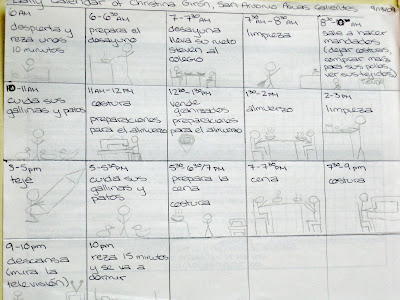
Tuesday was also the day that we presented the results of our PACA, a community analysis tool that we did with our host families. Each training group gathered their families together in order to draw community maps (giving us insight into what places were important for the residents of the community), create daily and seasonal calendars (in order for us to determine what would be good times to hold meetings with community groups). We did our community mapping the week before FBT and the results were a little disappointing. Only two of our mom’s were able/willing to participate, and they started drawing their houses and the store, but quickly got embarrassed by how their drawings looked and stopped entirely. The children (we did another map with kids) just started drawing all of the games that were in the central plaza for Independence Day and forgot entirely about the rest of town. In contrast with our maps, which were pretty empty, other towns had really detailed maps, though I was told that none of them were actually physically accurate. This activity was just practice for our future site placements as activities to do with our community groups, so I am curious to see how it will work in the future, hopefully the women will be less embarrassed about their artwork.

Women's Map of Santa Catarina

I also did a daily calendar with Mamatina on my own. Her daily calendar is significantly different than those of the other mothers in our group since she has a little store and does not do any farming and her children are grown. A good amount of her day is dedicated to her income sources – weaving and sewing. Mamatina is a really good seamstress and she told me the other day about how she went to Guatemala City when she was a girl (maybe fourteen years old) to learn how to sew in a woman’s house. She lived there for two years on her own, learning how to sew and eating very little food since the woman she lived with was poor. Mamatina’s life experiences sound really difficult and the fact that she has achieved financial stability and a nice house is definitely a reflection of her hard work and business acumen, nothing was given to her.

Mamatina's Daily Calendar

On Wednesday afternoon, all the folks from my town headed to Guatemala City in order to meet with two different organizations that work with women’s issues. The idea is that since we are more advanced and do not have Spanish classes that we have time to go visit all these organizations and then report back to the group. Needless to say other towns are somewhat irritated by the constant referrals to us as the avanzados. I tried to convince our trainer Carlos that it would be better to call us superiores, but for some reason he did not heed my advice:P Anyhow, we have gone on previous interviews with government agencies, and this time we split up with two going to talk to the Secretaría Presidencial de la Mujer (SEPREM), a government agency headed by President Colom’s wife. Felicia and I went to UNIFEM, the UN Fund for Women, which has a branch office here in Guatemala. The UNIFEM office is in a huge four-tower complez in Zona 14, pretty much the ritziest part of town. When Felicia and I got there, we were made to wait around 40 minutes and then when we were finally seen, we had a bunch of information thrown at us and were told to come back on Monday to discuss how we could collaborate after we read all the information. Given the short interchange that we had, it seems pretty clear to me that collaborating with UNIFEM will not really be possible during our service since they work at the national level with lobbying and policy-making, while our job as PCVs is to work at the local level. UNIFEM does policy and national campaigns; it does absolutely no execution on the ground…so we’ll see how the second meeting goes. It was a trip to see the offices of UNIFEM, more specifically the location of the offices really, since it is basically like any nice business area of a U.S. city, quite a change of scenery from where we have been living and where we will be working.

On Thursday we went back to Peace Corps for the second of three visits this week in order to listen to presentations by two more organizations that work with women’s issues here in Guatemala. CODEFEM presented first and was really impressive. They are a private, feminist, non-religious organization that has been lobbying for women’s rights for years and they have been fighting to ensure that every municipality has an OMM (Oficina Municipal de la Mujer – Municipal Women’s Office). Eight years ago the number of municipalities with OMMs were in single-digits, while today there are over 240 municipalities (out of 333 total I think) with OMMs. Every municipality should ideally have an OMM, however in the Municipal Code it was not made clear whether the municipality needed to have one and where it would fit in (that is, its position within the municipality organizational chart and what personnel it should have). CODEFEM along with other feminist organizations and government groups are working to revise the Municipal Code to make it mandatory for every municipality to have an OMM and to define what the OMM should be doing. The lady who came and talked to us was really passionate and inspirational, and she told us that when we get to our sites and we find out what our OMM needs, we could get in touch with CODEFEM to see if they could come and give trainings or some sort of assistance to our offices. The next speaker we had was a representative of CONAPREVI, the government ministry that deals with domestic violence and violence against women. Recently, in 2008 I think, Guatemala passed a law that mandated harsh punishments for violence against women and femicides. The laws were put in place to address the sad reality that there is a high rate of violence perpetrated against women solely because they are women. The laws are meant to ensure that any perpetrator of violence against women has to serve a prison sentence that cannot be plea-bargained away or paid off. While the laws look good on the books, CONAPREVI has had a hard time convincing judges to enforce them, and the statistics on violence against women, while not accurate are also really depressing. One man I know who will not be perpetrating any type of violence towards women is my Guatemalan love who is a mere few days away from turning six-months old. Kenny has gotten one tooth and a lot grabbier since our first meeting (my earrings and glasses were easy targets), but he remains the chillest baby I have seen, he does not fuss and is happy to be carried around by all family members, including the colocha.


With Kenny

On Friday I woke up feeling a little worse for wear but I figured it was the result of waking up before six am a few times this past week. I went with Felicia to the local school to give our last in the three part trash/recycling series of talks. When we got to the school, all the teachers were in a meeting and kids were running wild through the hallways. We got to the classroom and started doing our talk about different types of trash and then our activity: trash art. With my kids

While we were giving the talk and later when I was helping the kids do art I felt really drained and had stomach pain and hot flashes. Luckily for me, I was able to make it home before puking up the contents of my stomach. I suspect that the culprit of my malestar were the funny-smelling beans I ate the day before (they were pureed black beans that had been sitting out all day without being reheated or refrigerated). My morning was decidedly unpleasant, and in the afternoon I pulled myself together to go to Peace Corps for yet another series of presentations, but instead went to the medical office. The nurses offered me Gatorade, Pepto-Bismol and an anti-nausea shot (which I kindly declined) and with that I was set. Of all my illnesses due to food experiences in Latin American countries, this was probably the tamest since it did not involve me getting hooked up to an IV, I recovered within 24-hours, and I got some free Gatorade (there is always some neon-orange lining around cloud of illness). Now every one of us in my town has gotten sick due to food, Mamatina had been very proud that she fed me the best food, and I am hoping that I learned my lesson: eat beans hot or not at all.

On Saturday I went on a walk in the morning, I tried to run and my stomach said NO, and then went to Antigua to meet with Nelly, the head of Namaste-Direct here in Guatemala. Namaste-Direct is a microfinance institution that has been giving loans to groups of women through intermediary NGOs (like CARE). In January 2008, Namaste-Direct opened up an office in Antigua in order to give loans directly, though they still work with intermediary NGOs to find their groups of women. Namaste-Direct currently works with around 350 women in women’s groups in four departments (Chimaltenango, El Quiche, Sacatepéquez…and one more). They have a 24-month period where they give loans (loan cycles are on average 6-months long, so the ideal is to have women go through four loan cycles) and along with receiving money the women receive training and one-on-one business mentorship by local business-people (the mentors have to be Guatemalan and speak the local dialect among other qualifications). I was put in touch with Nelly, the head of the Guatemala office, through IRPS connections (thanks Preston!) and she has come up with a few projects that she would like me to do for her. The one project that really appealed to me was to help her improve the monitoring and evaluation tools that N-D is currently using. Every loan cycle there are a lot of diagnostic tools used to attempt to assess how the women are faring and whether the program is really helping them salir adelante. Nelly thinks that the monitoring program could use some improvements, but she does not have the time to figure out how to improve it since the day-to-day operations take up all her time. Revising the monitoring and evaluation strategy will be a long-term project, and since I will be here for two years, it would be a good match. I was very excited about the possibility with actually using some of my IRPS ‘toolkit’, but until I find out my site (THURSDAY!!!) and the work that I need to do at my site, I cannot commit to anything. I got some materials and will wait until I am in site a few months to figure out what I can commit to, but I am hopeful that I will be able to work with N-D.

I finished up my day on Saturday completing my embroidered pillowcase that I started with Mamatina about a month ago. One week Mamatina asked me if I wanted to learn how to embroider. I figured since I had a lot of time on the weekends that it would be a neat idea. At first I was going to make a napkin for my tortillas, but Mamatina decided that it would actually be better to learn how to make a pillowcase so I could embroider one for my future husband and then for my children. I informed her that I was hoping to marry a man who would have enough money to pay for someone else to embroider the pillowcases, but she would have none of that. I told her that with my lack of dexterity I could only look for a blind husband, or that my pillowcase would only be put on pillows in the dark. Below are the results of my efforts, as they say in Guatemala, it came out ‘dos que tres’ (literally: two out of three, figuratively: not so good, not so bad).

My pillowcase or sobrefunda